
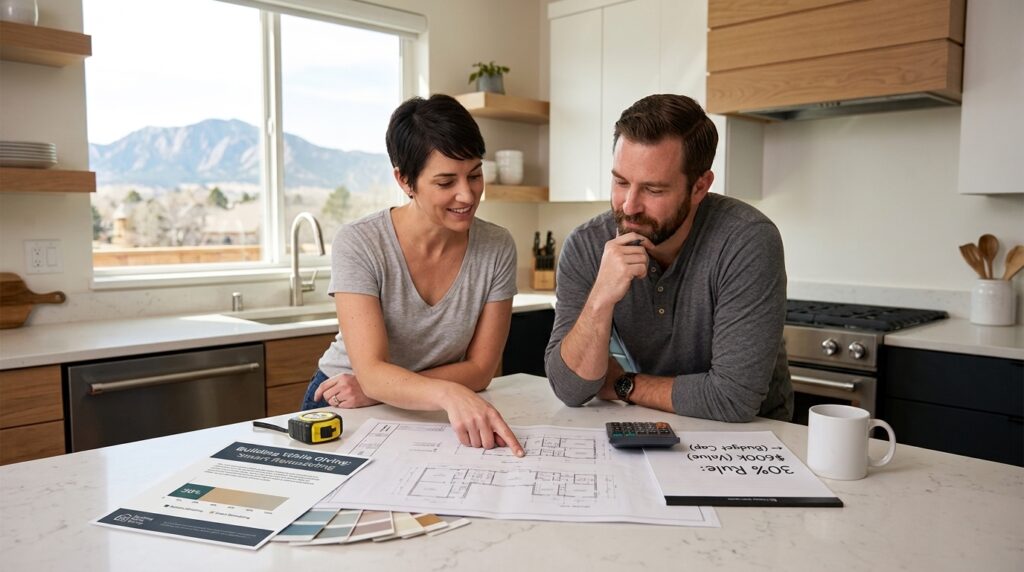
If you’re planning a remodel, you’ve probably heard about “the 30% rule.” It sounds official. Like a building code or a bank requirement. It’s neither.
The 30% rule is a simple budgeting guideline. Once you understand how it works, and when to break it, you can plan your remodel with real confidence.
At Building While Giving, we help Denver homeowners work through this question every week. Here’s what you need to know.
What Is the 30% Rule in Remodeling?
The 30% rule says this: don’t spend more than 30% of your home’s current value on remodeling.
So if your home is worth $600,000, your remodeling ceiling is about $180,000. That number covers everything: labor, materials, permits, design fees, and a cushion for surprises.
Why does this rule exist? It protects you from over-improving. That’s when you put more money into your home than you could ever get back when you sell. Say you spend $250,000 remodeling a $400,000 home, but houses on your block top out at $500,000. Some of that money is gone for good.
There’s a second idea that goes hand in hand with this one: the neighborhood ceiling. Even if the 30% math says you can spend more, your finished home shouldn’t be worth far more than similar homes nearby. The 30% rule sets your budget cap. The comps set your value ceiling. When in doubt, use the lower number.
One quick note. Some contractors use “30% rule” to mean something else: setting aside 30% of your budget for unexpected costs. That’s smart advice too. But in this post, we’re talking about the home-value version.
How the 30% Rule Works: Denver Metro Examples
The rule is tied to your home’s value, so the math looks different across the metro. Here are some 2026 examples using local median values, drawn from the Denver Metro Association of Realtors’ monthly Market Trends Report and other market data:
- Denver: The median sale price is about $616,000. Your 30% ceiling is roughly $185,000.
- Arvada: Typical home values sit near $614,600. That’s a ceiling of about $184,000.
- Castle Rock: Around $647,000, for a ceiling of roughly $194,000.
- Breckenridge and Vail: Mountain homes often top $1 million. Vail’s typical value is over $1.76 million. Up there, the 30% ceiling can pass $500,000, so mountain remodels rarely bump against it.
One important thing: that 30% is your total remodeling budget. It’s not a per-room allowance.
A helpful way to break it down is by room. A common guideline is 10% to 15% of your home’s value for a full kitchen and 5% to 10% for a bathroom. On a $600,000 Denver home, that puts a kitchen in the $60,000 to $90,000 range.
When to Follow the Rule (and When to Break It)
The rule works best when you plan to sell. If you’ll list your home within five years, staying under the 30% cap helps you get your money back.
But it’s a guideline, not a law. Here’s when it makes sense to bend it:
- You’re in your forever home. Staying 15 or 20 years? Then daily life matters more than resale math. A kitchen you love every morning has a value no spreadsheet can capture.
- You’re doing a whole-home remodel. The 30% rule was built for single projects. For a full renovation, many pros use a different benchmark: keep total spending under about 50% of your home’s post-renovation value.
- Your home is priced below the neighborhood. If nearby homes are worth more than yours, that gap is your headroom. You can invest more and still stay under the ceiling.
- You’re adding an ADU or addition. These add square footage, and often rental income. They grow your home’s value instead of just spending against it.
Where Your Money Works Hardest: Cost vs. Value
The 30% rule tells you how much to spend. Return-on-investment data tells you where to spend it.
The 2025 Zonda Cost vs. Value Report tracks this across the country. Here’s what it shows for the Mountain region, which includes Colorado:
- Minor kitchen remodel: about $28,490, returning roughly 110% at resale. It’s the only interior project that returns more than it costs.
- Major kitchen remodel: about $81,540, returning roughly 49%.
- Bathroom remodel (midrange): about $24,920, returning roughly 69%.
- Basement remodel: about $49,760, returning roughly 78%. That’s one of the strongest interior returns in the report.
The pattern is clear. Smart, targeted updates beat sprawling luxury overhauls on pure resale numbers. That doesn’t make a big remodel wrong. It just means you should know your goal. Are you spending for resale, or for the way you live?
Basements deserve a special mention in Denver. Finishing one typically costs $65 to $105 per square foot here, and it adds real, livable square footage without the cost of an addition. Learn more on our basement remodeling page.
What’s Different About Remodeling in Denver
A few local factors shape how the 30% rule plays out on the Front Range:
- Home values have cooled a bit. Several Denver-area markets are down slightly from last year. Get a current valuation before you run the math instead of relying on a peak-market number.
- Labor costs run high. Denver’s construction labor market is tight, and trade rates often run above the national average. Build that into your budget.
- Permits and altitude add cost. Denver permit fees rise with project value. Colorado’s snow loads, energy codes, and radon rules can add real dollars too, especially on additions.
- ADUs are easier to build than ever. A new Colorado law (HB24-1152) now requires many cities to allow accessory dwelling units in residential zones. A Denver ADU typically costs $150,000 to $350,000, but it can bring in rental income for years. See our home additions and ADU construction page.
Build Smart, Give Back
The 30% rule comes down to one thing: investing in your home with clarity. Whether you’re refreshing a kitchen, finishing a basement, or adding an ADU, knowing your numbers up front means fewer surprises and a better result.
And when you build with Building While Giving, your project does more than improve your home. We donate a portion of every project to a nonprofit you choose. Your remodel becomes hope for a family or community that needs it.
Ready to talk through your project and your budget? Visit buildingwhilegiving.com or call (720) 968-7874. Let’s build something meaningful together.