
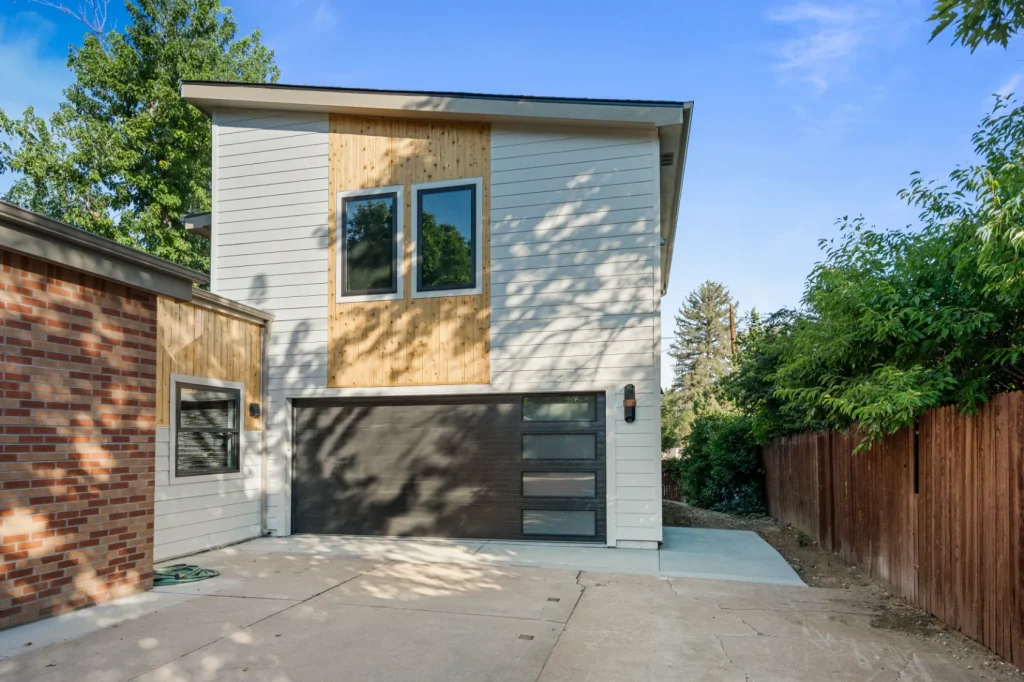
If you’ve been watching Denver’s real estate landscape with one eye and your own backyard with the other, you might already sense that something big is happening on residential lots across the metro. Accessory Dwelling Units (ADUs) have quietly become one of the most powerful tools a Denver homeowner can use to grow equity, generate income, and future-proof their property.
At Building While Giving, we don’t just build homes, we build financial futures for our clients while giving back to the communities we serve. So when homeowners ask us whether an ADU is worth it, our answer is almost always the same: in Denver’s market, a well-built ADU isn’t just a nice addition. It can be a game-changer for your property’s value.
Let’s break down exactly how ADUs move the needle on property value here in Denver — and why more homeowners are making this investment right now.
Table of Contents
Denver’s Housing Market: Why ADUs Are a Perfect Fit Right Now
Denver has consistently ranked among the most competitive housing markets in the country. Home values in the metro have appreciated significantly over the past decade, driven by population growth, a booming tech and outdoor recreation economy, and a chronic shortage of housing supply. Even with recent interest-rate pressures softening some price gains, Denver remains a seller’s market in most neighborhoods.
That’s exactly the environment where ADUs thrive. When housing is tight and rental demand is high — both of which describe Denver to a T — adding a legal, livable secondary unit to your property is one of the surest ways to increase what buyers and appraisers see when they evaluate your home.
Denver’s Office of Housing and Community Development has also been proactively streamlining ADU permitting in recent years, making it easier than ever for homeowners in many residential zones to move forward with construction. When the city makes it easier to build, savvy homeowners listen.
The Numbers: How Much Can an ADU Add to Your Property Value?
Here’s the question every homeowner wants answered up front: what’s the actual dollar impact? While every property is different, national and regional data paint a compelling picture.
Research consistently shows that ADUs can add between 20% and 35% to a home’s overall resale value, depending on the type of ADU, quality of construction, neighborhood, and rental income potential. In a high-demand market like Denver, those numbers often land toward the top of that range — or exceed it.
Consider these realistic scenarios:
• A home valued at $600,000 in Englewood or Lakewood gains an estimated $120,000–$210,000 in appraised value after adding a well-designed detached ADU.
• A basement conversion ADU costing $80,000–$120,000 to build can generate $1,400–$2,200/month in rental income in Denver’s current market — a return that directly increases the property’s income-based valuation.
• Homes with permitted, livable ADUs attract a broader pool of buyers, including investors, multigenerational families, and house-hackers — which increases demand and supports stronger sale prices.
The key word throughout all of this is permitted. An unpermitted ADU can actually hurt your value or create legal headaches at closing. Working with a licensed, experienced contractor — like our team at Building While Giving — ensures your ADU is fully code-compliant and adds the maximum possible value.
Types of ADUs and Their Value Impact in the Denver Market
Not all ADUs are created equal — and in Denver, the type you build matters for both cost and value return. Here’s how the most common types stack up:
Detached ADUs (Backyard Cottages & Guest Houses)
These standalone structures are the crown jewel of ADU construction. Because they offer maximum privacy and independence, detached ADUs command the highest rental rates and the biggest bump in appraised value. In Denver’s popular neighborhoods — think Wash Park, Stapleton/Central Park, or Arvada — a thoughtfully designed backyard cottage can generate premium rents and make a home genuinely stand out in a competitive listing environment. Budget typically ranges from $200,000–$400,000+, but the return on investment can be exceptional over a 5–10 year horizon.
Garage Conversion ADUs
Converting an attached or detached garage into a livable unit is one of the most cost-efficient ADU strategies available to Denver homeowners. The structure already exists, which reduces both construction time and cost — often coming in between $80,000 and $160,000 depending on finishes. The value added tends to be strong relative to investment, particularly in older Denver neighborhoods where garages are common but housing square footage is at a premium.
Basement ADUs (Below-Grade Conversions)
Basement ADUs are particularly popular in Denver’s older bungalow-heavy neighborhoods like Berkeley, Sunnyside, and Congress Park. Converting an underutilized basement into a permitted rental unit can be the most accessible entry point for homeowners, often running $70,000–$130,000. While the value increase per square foot may be slightly lower than a detached unit, the combination of rental income and added livable square footage makes this one of the most financially compelling moves in the Denver market.
Attached ADUs (Home Additions with Separate Entry)
Adding onto your home with a connected but separate living space offers flexibility for multigenerational families who want proximity without sacrificing privacy. These projects vary widely in scope and cost, but they can be highly effective for increasing marketable square footage and broadening buyer appeal when it’s time to sell.
Rental Income: The Secret Multiplier
Here’s something that a lot of Denver homeowners don’t fully appreciate until they run the numbers: an ADU’s rental income directly influences how an appraiser values income-producing real estate.
In Denver, average monthly rents for a well-designed one-bedroom ADU range from $1,400 to $2,500, depending on neighborhood and amenities. That monthly income gets capitalized into your property’s appraised value — meaning consistent rental income doesn’t just help your cash flow, it formally increases what your home is worth on paper.
Beyond appraisal, there’s a very real pool of buyers in Denver who are specifically searching for “house-hacking” opportunities — properties where rental income from an ADU can help them qualify for or afford a mortgage. This expands your buyer pool significantly when you eventually sell, which supports a stronger sale price.
When you think about it that way, an ADU isn’t just a construction project. It’s an investment vehicle — one that pays you every month before you even consider what it does for your equity.
Denver Zoning: What You Need to Know Before You Build
Denver has been making meaningful strides to encourage ADU construction as part of its broader housing affordability strategy. Under Denver’s current zoning code, ADUs are permitted by right in most single-family residential zones — meaning you don’t need a special variance in many cases, just the proper permits.
A few important considerations for Denver ADU projects:
• Lot size matters: Most Denver zones require a minimum lot size (often around 6,000 sq. ft.) for a detached ADU.
• Owner-occupancy requirements: Some Denver zones require the owner to live on the property, though these rules have been relaxed in recent years.
• Height and setback limits: Detached ADUs are typically limited to a specific height (often 24 feet) and must observe setback distances from property lines.
• Parking: Requirements vary by neighborhood proximity to transit corridors.
• Design standards: Denver encourages ADUs that are compatible with the primary home’s architectural style.
Navigating these rules is one of the most important reasons to work with a contractor who lives and builds in Denver. Our team knows the zoning code, has relationships with the city’s permitting office, and can help you design a project that checks every box before a single shovel hits the ground.
Multigenerational Living: Value Beyond the Dollar Amount
At Building While Giving, we believe a home’s value isn’t measured only in dollars — it’s also measured in the quality of life it provides for the people inside it. And on that front, ADUs deliver something uniquely powerful: the ability to keep families connected across generations without sacrificing independence.
More Denver families are choosing to house aging parents in a backyard cottage rather than transitioning them to a care facility. Others are building ADUs for young adult children — allowing them to launch their lives with support nearby while the parents retain their own space. In a city where the cost of living has climbed steeply, this kind of multigenerational flexibility has real, tangible financial value for families.
When a home meets this kind of need, it becomes something more than square footage. It becomes a legacy — and that’s an asset that doesn’t appear on any appraisal report, but it’s felt by every family who lives it.
Design Quality: Why It Matters for Value
Not every ADU is created equal — and in a market as sophisticated as Denver’s, design quality makes a real difference in how much value your unit adds.
High-impact design elements that boost ADU value in Denver include:
• Natural light: Generous windows and skylights create spaces that feel larger and more livable, commanding higher rents.
• Energy efficiency: High-performance insulation, efficient HVAC, and solar-ready construction reduce utility costs — a strong selling point for renters and buyers alike.
• Architectural compatibility: An ADU that looks like it belongs on the property, complementing the main home’s style, reads as intentional and premium — not an afterthought.
• Quality finishes: Durable, attractive materials in the kitchen and bathroom communicate lasting value and attract quality tenants.
• Smart home technology: Keypad entry, smart thermostats, and connected lighting appeal to Denver’s tech-savvy rental demographic.
The bottom line is this: a thoughtfully designed, professionally built ADU doesn’t just add square footage. It adds a premium product to your property that the market will recognize and reward.
The Building While Giving Difference
Every project we take on at Building While Giving is guided by a simple belief: building something great should make the community better, not just the property. That’s why a portion of every project we complete goes directly back into supporting Denver-area families and causes. When you invest in your home with us, you’re investing in something bigger.
Our ADU construction team brings deep knowledge of Denver’s zoning landscape, local subcontractor relationships, and a genuine commitment to craftsmanship that shows up in every detail — from permit drawings to final walk-through. We’re a licensed, insured Colorado contractor, and we’ve built our reputation in this market one transparent, well-executed project at a time.
Whether you’re dreaming of a backyard guest house, a rental-generating basement apartment, or an in-law suite for a parent who deserves to stay close, we’d love to be the team that brings it to life.
Final Thoughts: Is an ADU the Right Move for Your Denver Home?
In a housing market defined by limited supply and persistent demand, an ADU gives Denver homeowners something rare: a way to create value, not just capture it. Whether you’re motivated by rental income, multigenerational flexibility, or the long-term equity play, a well-built ADU is one of the smartest investments you can make in your property right now.
The Denver market rewards quality, rewards permitted and legal construction, and rewards homeowners who think ahead. An ADU checks every one of those boxes.
If you’re ready to explore what an ADU could look like on your property — and what it could mean for your home’s value — the best first step is a conversation.
Ready to Talk About Your Home?
Schedule your free consultation at buildingwhilegiving.com/contact-us
or call us at (720) 968-7874
Happy building! 🏠✨