

Hiring a contractor for a commercial space is different from hiring one for a house. The stakes are higher. A late opening costs rent, payroll, and revenue. A permit mistake can stall a lease. And the person signing the contract is often answering to an owner, a board, or a tenant who wants the space open yesterday.
If you manage property in Denver or run a business that needs its space built out, you have probably searched for a commercial general contractor and found a long list of names that all say the same thing. This guide helps you sort them.
Here is what to look for, in the order it usually matters.
Start with the Denver contractor license
Colorado does not license general contractors at the state level. Cities and counties do. In Denver, commercial work is permitted through the City and County of Denver, and the contractor pulling those permits needs a Denver contractor license in the right class for the job.
Ask for the license number. Then check it. Denver’s Community Planning and Development contractor licensing page explains how licenses are issued and links to the public lookup. It takes about a minute. You want to see an active license, the correct class for the scope, and no red flags.
This one step filters out a surprising number of candidates. Some “commercial contractors” are actually subcontractors who have only ever worked under someone else’s permit. That is fine for a trade partner. It is not fine for the company running your project.
Building While Giving is a licensed Denver contractor (Lic. LIC00254663). We handle commercial tenant improvements and interior buildouts as the general contractor on the job, which means we pull the permits, manage the trades, and own the schedule.
Match their experience to your project type
Commercial work covers a lot of ground. A restaurant buildout, a dental office, a multifamily common area, and a retail storefront all have different code requirements, inspection paths, and trade sequences.
Ask what kinds of commercial projects the contractor has completed in the last two years. Then ask which ones are most like yours. A contractor who is honest about their focus is more useful than one who claims to do everything.
Our own focus is clear. We improve existing commercial space. Tenant improvements, office buildouts, retail interiors, and multifamily unit and common area work. We do not do ground-up construction, and we will tell you that up front. If you want a deeper look at how these projects run, our guide to tenant improvement projects in Denver walks through allowances, permits, and timelines.
Ask how they handle permits and inspections
This is where commercial projects most often lose time. Denver’s permitting process for commercial work involves plan review, and depending on the scope, it can involve fire, health, zoning, and accessibility review too.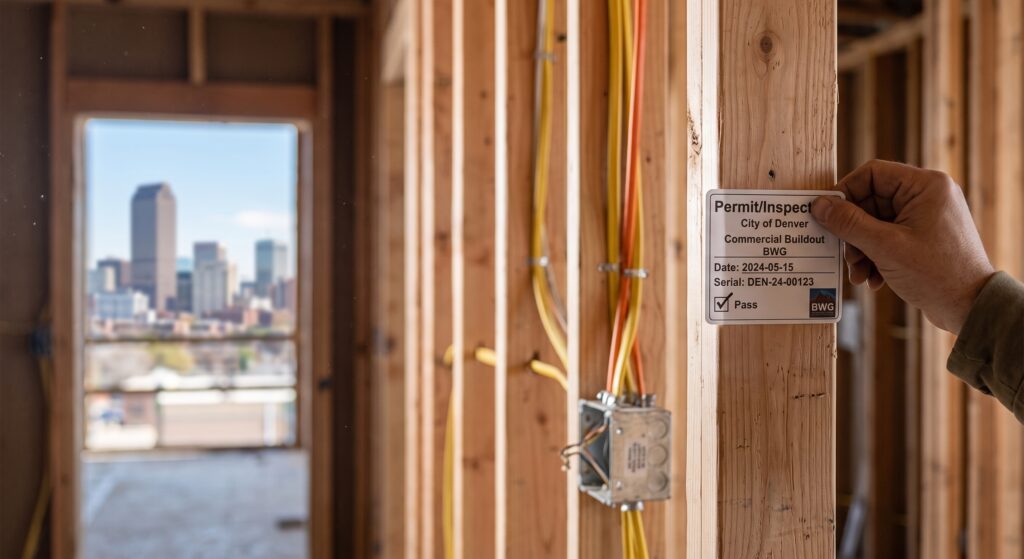
A good commercial GC should be able to walk you through the likely permit path for your project before you sign. Ask them:
-
- Who prepares and submits the permit application?
-
- What is a realistic review timeline for this scope right now?
-
- How do you schedule inspections so they do not hold up the trades?
-
- Have you worked with Denver’s Community Planning and Development on a project like this?
If the answers are vague, keep looking.
Look for a clear scope and a real schedule
Ask for a written scope of work that lists what is included, what is excluded, and what assumptions the price depends on. Then ask for a schedule that shows the major milestones: permit submittal, demo, rough-ins, inspections, finishes, and turnover.
A schedule with dates is a commitment. A schedule with “TBD” next to every line is a guess.
Also ask how the contractor handles changes. Changes happen on every commercial job. What matters is whether they are priced, approved in writing, and tracked, or whether they show up as a surprise on the final invoice.
Check insurance and get the certificates
At minimum, you want general liability and workers’ compensation coverage. Many commercial leases and property owners also require the contractor to name the landlord as an additional insured.
Do not take “we’re insured” as an answer. Ask for the certificates of insurance and confirm the coverage dates run through your project.
Talk to a recent commercial client
References matter more in commercial work because the relationships are longer. A property manager who has used the same GC for three buildouts can tell you exactly how they communicate when something goes wrong.
Ask for a reference from a project similar to yours. Then actually call.
Pay attention to how they communicate before the contract
The way a contractor handles your first three emails is a preview of how they will handle your project. Do they respond within a business day? Do they answer the question you asked? Do they send the license number and insurance certificates without being chased?
Commercial projects run on communication. Choose a contractor who is already doing it well.
Frequently asked questions
Does Colorado require a state license for general contractors? No. Colorado licenses electricians and plumbers at the state level, but general contractor licensing happens city by city and county by county. A contractor working in Denver needs a Denver license. A contractor working in Aurora or Lakewood needs a license from that city.
What license class does a contractor need for commercial interior work in Denver? Denver issues building contractor licenses in several classes, and the right one depends on the building type and scope. Interior, non-structural commercial work is typically done under a Class A or Class B license. Rather than memorize the classes, ask the contractor which class they hold and confirm it on Denver’s lookup.
How do I verify a Denver contractor license? Ask the contractor for their license number, then check it through Denver Community Planning and Development’s online license lookup. The record shows whether the license is active, the class, and the expiration date.
What is the difference between a general contractor and a subcontractor on a commercial job? The general contractor holds the permit, carries the overall contract with you, and manages the schedule and the trades. Subcontractors (electricians, plumbers, framers, painters) work under the GC. When you hire a GC, you have one point of accountability for the whole project.
A note on how we work
Building While Giving started in Denver residential remodeling, with whole home projects across the metro from Denver to Arvada. That background shapes how we run commercial jobs. We keep the language plain, the schedule visible, and the surprises to a minimum. Giving is built into how we work too. Every project we complete helps us give back to the Denver community.
If you are planning a tenant improvement, office buildout, or retail or multifamily interior project in Denver, we would like to talk. Learn more about our commercial construction and tenant improvement services or contact us at (720) 968-7874 or info@buildingwhilegiving.com to get started.