
A whole home remodel in Highlands Ranch is usually paid for with savings, a home renovation loan, or both, and most of the loan types covered below are secured by your home. Our published Denver metro range for whole home remodeling runs from $100,000 to $400,000+, so the funding plan matters as much as the design plan. This guide explains the main option types so you know what to ask before you sit down with a lender.
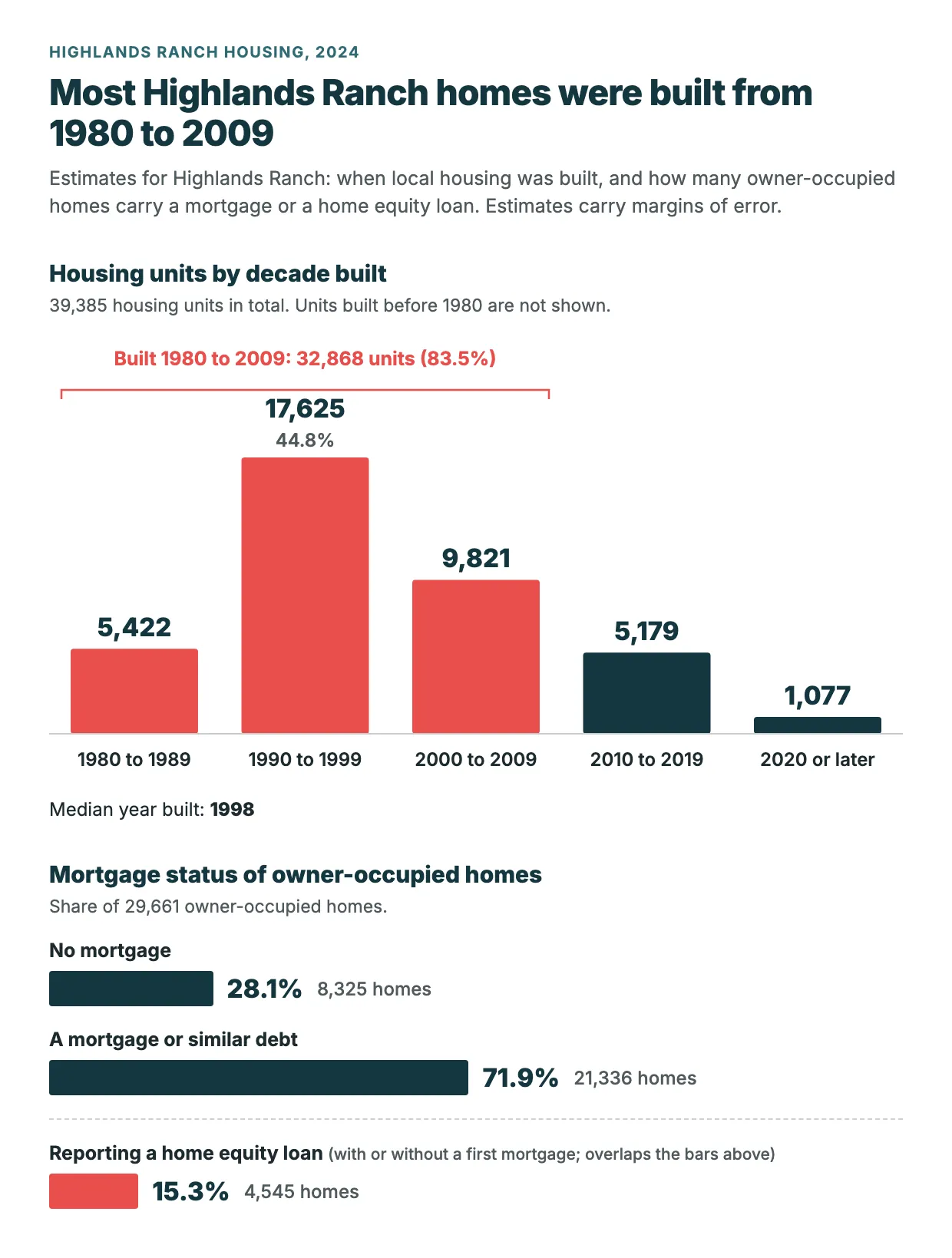
Housing age is why the question comes up in Highlands Ranch. The typical home here was built in 1998, and our Highlands Ranch remodeling page describes the same 1980s to early 2000s build-out: original oak cabinets, closed-off kitchens and finished basements that feel dated now. When several rooms need work at once, one planned project gives you one number to fund.
Our detailed written estimate gives you a project number to plan your funding around.
This post is general information, not financial advice. A lender, a HUD-approved housing counselor or a financial advisor can tell you what fits your situation.
Start with the number you are paying for
Your financing plan starts with a project number, and for a whole home remodel in the Denver metro, our published range is $100,000 to $400,000+. That range covers full-scope work across multiple rooms, flooring, kitchen, baths and systems, and our remodeling pricing page notes that it is based on real Colorado projects.
Where your project lands depends on scope, material selections and what turns up once the walls are open. We give you a detailed written estimate before any work begins. If conditions inside the walls reveal something unexpected, we discuss it with you before going further, so a surprise never shows up as a bill at the end.
Before you call a lender, set a budget range with a top number you will not go past. Our guide on how to budget for a whole home remodel covers ranges, contingency and phasing, and our whole home remodel cost guide for Castle Rock lays out three budget levels for a whole home remodel nearby.
This post picks up where the budgeting guide stops: once you have a number, how do you pay it?
Paying from savings, or savings plus a loan
Paying from savings means there is no loan to repay and no new loan tied to your home. You can also split the cost, using savings for part of the project and a loan for the rest.
Savings held outside the loan can cover what the estimate could not see.
Our pricing page lists existing conditions, meaning what we find when the walls open, as one of the main cost factors, and a Highlands Ranch house built in the 1980s or 1990s has had decades for its wiring and plumbing to age.
If savings cannot cover the full scope, phasing is the other lever. You might remodel the kitchen and main living areas first and come back for the bathrooms or basement later. Phasing spreads the cost out, though it also means living through more than one construction period.
What home equity means for a Highlands Ranch home
Home equity is the value of your home minus what you still owe on it, and HELOCs, home equity loans and cash-out refinances all borrow against it. In Highlands Ranch the starting value is high: the typical owner-occupied home is worth $739,500.
Here is where local owners stand today:
| Highlands Ranch owner-occupied homes (2024) | Share |
|---|---|
| No mortgage | About 28% |
| A mortgage or similar debt | About 72% |
| Already carrying a home equity loan | About 15%, or roughly 3 in 20 |
Borrowing against equity means your home is the collateral, so if you fail to make payments or meet other loan requirements, you could be at risk of losing your home through foreclosure. These loans also generally have upfront costs, which reduce the amount of equity you can use.
Which home renovation loan fits a whole home remodel?
The right home renovation loan depends on how much you need, whether you want the money all at once or over time, and what your current mortgage looks like. Here is how the common types work.
| Option | How you get the money | Secured by your home? | Worth knowing |
|---|---|---|---|
| HELOC (home equity line of credit) | You draw as needed, up to a limit, during a draw period that could last 10 years | Yes | Usually a variable rate, and payments are often much higher once repayment begins |
| Home equity loan | One lump sum | Yes, usually as a second mortgage | Usually a fixed rate, with its own monthly payment |
| Cash-out refinance | A new, larger mortgage pays off your current one, and you take the difference in cash | Yes | Your rate and loan terms change, and payoff may take longer |
| FHA Limited 203(k) | Repair costs are financed into your mortgage when you buy or refinance | Yes | Up to $75,000 for minor, non-structural work |
| FHA Standard 203(k) | Repair costs are financed into your mortgage | Yes | For major renovation and structural work, with a $5,000 minimum and a required 203(k) consultant |
| Fannie Mae HomeStyle Renovation | One loan and one monthly payment cover the mortgage and the improvements, when you buy or refinance | Yes | Existing homes only; a refinance covers up to 75% of the home’s appraised value after the work |
| Personal loan | A sum you repay on a set schedule | No | Does not use your home as collateral |
A HELOC lets you borrow repeatedly against your equity, which can match a remodel that bills in stages. One caution matters over a multi-month project: if the value of your home decreases significantly, your lender might decide not to allow you to take out additional credit.
A home equity loan pays out once, so it lines up with a fixed number from a written estimate. If you already have a mortgage, it becomes a second mortgage with a second monthly payment, usually over a shorter term than a 30-year loan.
A cash-out refinance replaces your first mortgage instead of adding a second one. The point to weigh is that your new interest rate and other loan terms change, and a new 30-year loan can stretch out the time it takes to pay off your home.
Renovation mortgages build the remodel into the mortgage itself. The Limited 203(k) tops out at $75,000, which sits below the $100,000 low end of our published whole home range. A lender can explain how each renovation mortgage would apply to the scope in your written estimate.
A personal loan does not put your home on the line, and the lender sets the amount and terms. It is a closed-end loan, so you borrow a set sum and repay it on a schedule.
Questions to ask before you sign
The questions to ask before you sign cover security, rates, upfront costs, payout timing, cancellation and taxes, and asking every lender the same ones lets you compare their answers side by side:
- Is this loan secured by my home? If so, ask what happens if a payment is missed.
- Is the rate fixed or variable? For a HELOC, ask how the payment changes when the draw period ends.
- What are the upfront costs? Loans secured by your home generally have them.
- How does the money reach the project? A lump sum, draws, or payments sent to the contractor all work differently, so ask how the lender’s schedule fits your contractor’s.
- Can I change my mind after closing? You have a right to cancel most refinances and home equity loans within three business days. Saturdays count as business days; Sundays and legal public holidays do not.
- Is the interest deductible? Interest on home equity loans and lines of credit is deductible only if the money is used to buy, build or substantially improve the home that secures the loan. A tax professional can tell you how that applies to you.
If you want a second opinion, a federal search tool lists HUD-approved housing counseling agencies. A lender can tell you which options are open to you, and a financial advisor can help you weigh them against the rest of your finances.
Matching the money to the remodel schedule
Have your funding in place before construction begins, because our process puts a deposit and design phase first. Your deposit secures your spot, and we finalize material selections and build the project plan before construction begins.
Most whole home projects take 2 to 4 months, depending on the size of your home, the scope of work and whether permits are required. On a loan secured by your principal home, federal rules generally hold back the money until the three-business-day right to cancel has passed, so build those days into your start date. After that, a home equity loan or cash-out refinance pays out all at once, a HELOC lets you draw as each stage bills, and renovation mortgages release funds in draws under the lender’s rules. Ask your lender how its timing lines up with the payment schedule in your contract.
Approvals affect the calendar, too. Highlands Ranch is an unincorporated community in Douglas County, so the county’s Building Division issues the building permits, and we handle the permitting process as part of your project.
If your plans change the outside of the house, the Highlands Ranch Community Association requires architectural approval before most improvements; our post on home addition costs in Highlands Ranch explains that review in more detail.
Planning your Highlands Ranch remodel with Building While Giving
We don’t offer in-house financing, but during your consultation we can talk through options with lenders we’ve worked with. The process starts with a contact form and a consultation call about your goals, scope, timeline and budget, followed by an on-site visit and a detailed written estimate before any work begins.
A whole home remodel with us also funds a cause. 5% of our profit on every project goes to a nonprofit of your choice.
FAQ
What is a home renovation loan called?
A home renovation loan goes by several names, depending on how it works. The common types are a home equity line of credit (HELOC), a home equity loan, a cash-out refinance, renovation mortgages such as the FHA 203(k) and Fannie Mae’s HomeStyle Renovation, and unsecured personal loans. Each pays out differently: a HELOC in draws, a home equity loan or personal loan as one sum, a cash-out refinance as cash from a new, larger mortgage, and a renovation mortgage as repair funds built into the mortgage.
Is $100,000 enough to renovate a house?
It can be, depending on the scope. Our published Denver metro range for whole home remodeling starts at $100,000 and runs to $400,000+, and where a project falls depends on the number of rooms, material selections and existing conditions. A written estimate after an on-site visit gives you a number for your house specifically.
What is the 30% rule for home renovation?
The 30% rule is a budgeting guideline that suggests spending no more than 30% of your home’s current value on remodeling. Our post on the 30% rule in remodeling explains how it works and when it makes sense to set it aside.
Does Building While Giving offer financing?
No, we don’t offer in-house financing. During your consultation, we can talk through options with lenders we’ve worked with.
Can I deduct interest on a home equity loan used for a remodel?
Possibly. Interest on home equity loans and lines of credit is deductible only if the borrowed money is used to buy, build or substantially improve the home that secures the loan. Ask a tax professional how the rule applies to your return.
Ready to get started? Call Building While Giving at (720) 968-7874 or schedule a consultation.