
Basement finishing in Castle Rock typically falls in our published Denver metro range of $30,000 to $60,000+ for framing, drywall, flooring, lighting, electrical and finish work. Bedrooms, a bathroom and the code items that come with them help decide where your project lands in that range or above it. The Town’s permit fees and use tax also apply to the project, and you can always ask what an estimate includes. National cost guides put most basement finishes between $15,000 and $75,000, which tells you how much the scope matters.
Castle Rock adds a few local lines to the math. The Town charges a building permit fee and a plan review fee based on your project’s value, plus a 5.2% use tax on materials, all charged on your permit. Most homes here are also young: three in four were built in 2000 or later.
We’re expanding into Castle Rock and bringing the same written estimates and permit handling to basement remodeling here that we use across the Denver metro.
What basement finishing in Castle Rock costs
A basement finish in Castle Rock typically falls in our published Denver metro range of $30,000 to $60,000 or more, depending on the size of the space and how many rooms, fixtures and code items it includes. That range sits on our remodeling pricing page, based on real Colorado projects, and it covers framing, drywall, flooring, lighting, electrical and finish work.
Here is how that range compares with national figures:
| Benchmark | Figure | Source |
|---|---|---|
| Building While Giving, Denver metro range | $30,000 to $60,000+ | Our pricing page |
| National average, finished basement | $32,000 | National cost guide, 2026 |
| National typical range | $15,000 to $75,000 | National cost guides, 2026 |
| National cost per square foot | $30 to $50 | National cost guide, 2026 |
| National basement bathroom addition | $10,000 to $25,000 | National cost guide, 2026 |
| National egress window | $2,000 to $5,000 each | National cost guide, 2026 |
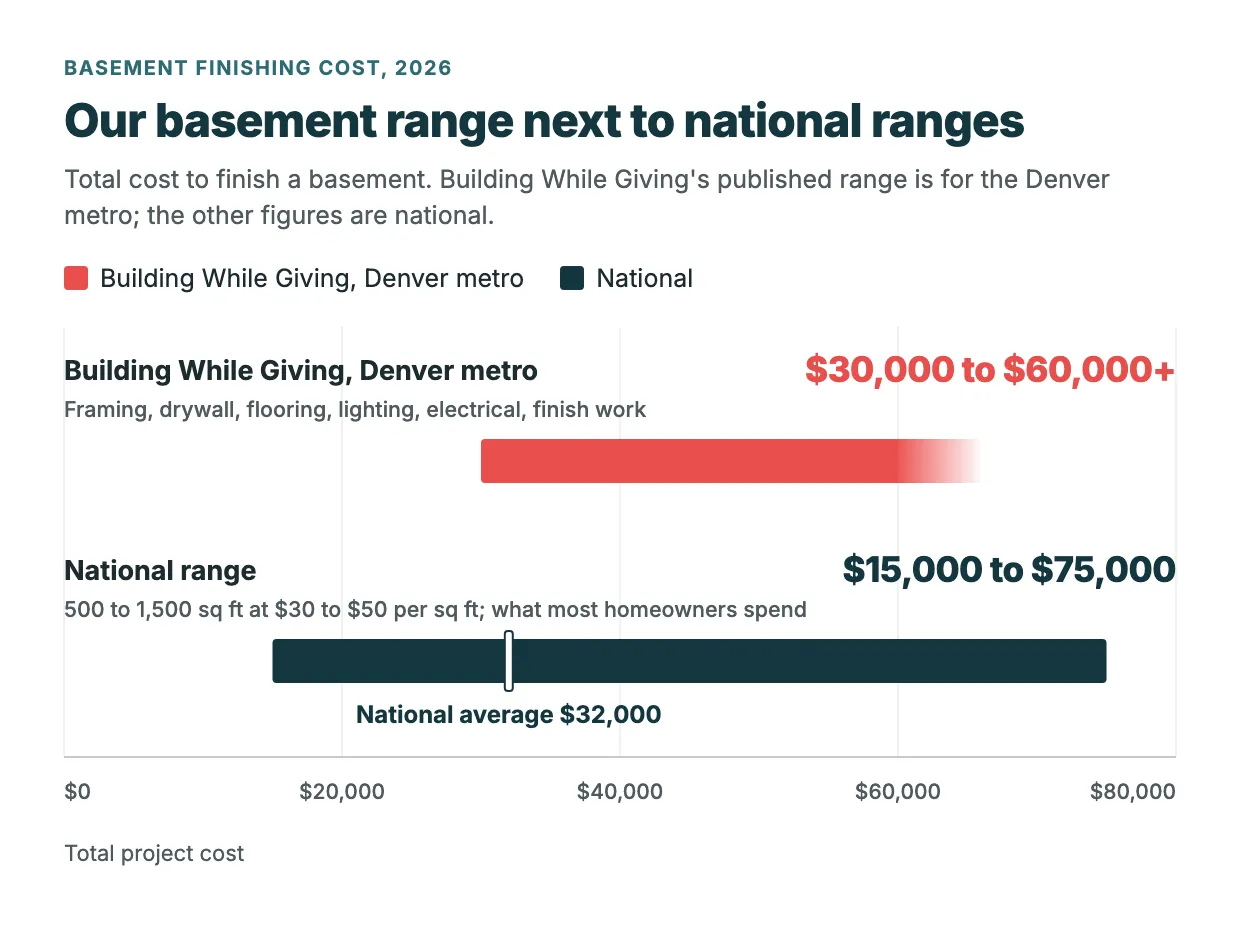
National numbers work as a sanity check until you have a Castle Rock estimate in hand. Because they are national, they cannot reflect the Town of Castle Rock’s own fee schedule and use tax, and their ranges span very different scopes, from an open-plan finish to one with several rooms and a bathroom.
What moves a Castle Rock basement budget
The rooms you add shape a basement budget, because each bedroom or bathroom brings its own code requirements, framing, electrical work and inspections. The Town of Castle Rock’s basement finish guide spells out what those rooms need.
- Bedrooms. Every basement, and every sleeping room in it, needs an emergency escape window or an exterior door. An escape window needs at least 5.7 square feet of openable area, a clear opening at least 24 inches high and 20 inches wide, and a sill no more than 44 inches off the floor. A window well deeper than 44 inches needs a permanent ladder. Our post on legal requirements for basement bedrooms covers the rest.
- A bathroom. New drains, venting and fixtures make a bathroom one of the bigger single additions, with national figures of $10,000 to $25,000. It is also one of the most popular basement upgrades we build. See how to add a bathroom in a basement for the planning steps.
- Alarms. Smoke alarms are required throughout the basement and in and outside any sleeping room, hard-wired with battery backup and interconnected. Carbon monoxide alarms are required on each floor with bedrooms.
- Ceilings and mechanicals. If a finished ceiling will be under 7 feet, the Building Department wants to review it. Furnaces and water heaters need at least 30 inches of clear working space in front and cannot sit in a bedroom or bathroom unless they are in a dedicated enclosure. Where that equipment sits can limit the layout.
- Flooring. We recommend luxury vinyl plank throughout a basement because it is durable and water-resistant, and we don’t recommend carpet in a basement because of the moisture risks common in the Denver area.
Town of Castle Rock permit fees and use tax
The Town of Castle Rock charges three costs at permit time on a basement finish: a building permit fee, a plan review fee and building use tax. All three are based on your project’s valuation, which the Town defines as the actual cost of the work, and the Town says fees should be reconciled against the total final cost when the permit closes.
Using the Town’s 2026 fee schedule, effective July 1, 2026, here is what those three charges come to at three example valuations:
| Example project valuation | Building permit fee | Plan review (65% of permit fee) | Use tax (5.2% of half the valuation) | Total of these three |
|---|---|---|---|---|
| $30,000 | $442 | $287 | $780 | About $1,509 |
| $45,000 | $593 | $386 | $1,170 | About $2,149 |
| $60,000 | $714 | $464 | $1,560 | About $2,738 |
These are worked examples from the Town’s published formulas, rounded to the dollar. They cover only these three charges, and your permit may carry others. The use tax is 4.2% for the Town and 1% for Douglas County, applied to construction materials, which the Town estimates at half the project’s valuation. Show your active permit when you buy materials and the vendor should not charge Town sales tax on them; purchases made before the permit is issued are not eligible for a refund. Our Castle Rock kitchen remodel cost guide walks through the same use tax on a kitchen.
Check your jurisdiction first. A Castle Rock mailing address can sit outside Town limits, and in unincorporated Douglas County the county’s Building Division issues permits instead, under its own fee schedule. The county requires a permit when walls are built or electricity is added to a basement, and you need the permit in hand before work begins.
What newer Castle Rock homes mean for a basement finish
Castle Rock’s housing is young, which can mean fewer surprises from aging systems and more attention to what the ground is doing. The typical Castle Rock home was built in 2008, and about 74.5% of homes date from 2000 or later.
Even a newer basement can carry two Colorado conditions that show up in the budget:
- Moving slabs. Expansive soil is Colorado’s most significant geologic hazard, and cracked or heaved basement floors are a very common sign of it. The Town’s basement guide calls for “floated” walls: where floors can heave, interior walls that don’t hold up the house should leave room for 1-1/2 inches of movement. Ask how your contractor will frame for it. Moisture matters for the same reason; our guide to waterproofing a basement before finishing it covers the prep.
- Radon. Radon is found at elevated levels in one out of every two Colorado homes and is responsible for about 500 lung cancer deaths a year in the state. A radon problem is easy to find and fix, and do-it-yourself test kits cost about $10 to $50. Testing before you finish lets any mitigation be planned before the walls and ceiling go up.
How to set a realistic basement budget
A realistic budget starts with the rooms you need, then adds the Town’s charges and a cushion for what the slab and walls reveal. These steps keep the number honest:
- Confirm who issues your permit. Whether it is the Town of Castle Rock or Douglas County changes the fee schedule and the review office.
- Decide on bedrooms and a bathroom early. Each bedroom brings an escape window and alarms, and a bathroom brings plumbing. Those choices move the price far more than paint, which runs $800 to $2,500 nationally.
- Test for radon. Do it before the design is final, so the result can shape the plan.
- Look at the slab and walls. Cracks, heaving or damp spots belong in the plan before anyone prices drywall.
- Get a written estimate after an on-site visit. A number built from your actual basement replaces the national averages.
- Add the Town’s charges. Use the table above as a starting point for permit, plan review and use tax.
For a broader look at finish levels and basement sizes across the region, our Denver metro basement finish cost guide breaks costs out by finish level and square footage.
Finishing your basement with Building While Giving
We’re expanding into Castle Rock and building our presence here, with the same process we use across the Denver metro. We don’t yet have completed Castle Rock projects to show you, and our Castle Rock remodeling page says so directly.
What you can count on is how we work. You get a detailed written estimate before any work begins, licensed and insured crews do the work, we handle the permitting when it is required, and most basement finishes take 4 to 14 weeks depending on scope and permits. Our pricing page puts it plainly: if conditions inside the walls reveal unexpected issues, we discuss it with you immediately before proceeding.
Castle Rock projects carry the same giving commitment as the rest of our work. 5% of our profit on every project goes to a nonprofit of your choice.
FAQ
What’s the average cost to finish an unfinished basement?
The national average is about $32,000, with most homeowners spending $15,000 to $75,000. Our published Denver metro range for basement finishing is $30,000 to $60,000+. In Castle Rock, the Town’s permit fee, plan review fee and 5.2% use tax on half the project’s valuation also apply to the project, so ask what any estimate includes.
What’s the most expensive part of finishing a basement?
Adding a bathroom is one of the largest single line items, at $10,000 to $25,000 nationally. Each bedroom escape window adds $2,000 to $5,000 nationally. Painting, by comparison, runs $800 to $2,500.
Can you finish a basement for $10,000?
Usually not for a full finish. Nationally, a partial finish runs $2,500 to $20,000 and a full finish at $15,000 to $75,000, and our published Denver metro range starts at $30,000.
When should you not finish a basement?
Hold off while you have unresolved water, an active moisture problem or untested radon. Cracked or heaved slabs can point to expansive clay, Colorado’s most significant geologic hazard, and one in two Colorado homes has elevated radon. Deal with both before the walls go up.
Do I need a permit to finish a basement in Castle Rock?
Yes. The Town of Castle Rock lists basement finishes among the common projects that require a permit. If your home is in unincorporated Douglas County, the county issues the permit and requires one when walls are built or electricity is added. We handle the permitting process as part of your project.
Ready to get started? Call Building While Giving at (720) 968-7874 or schedule a consultation.